
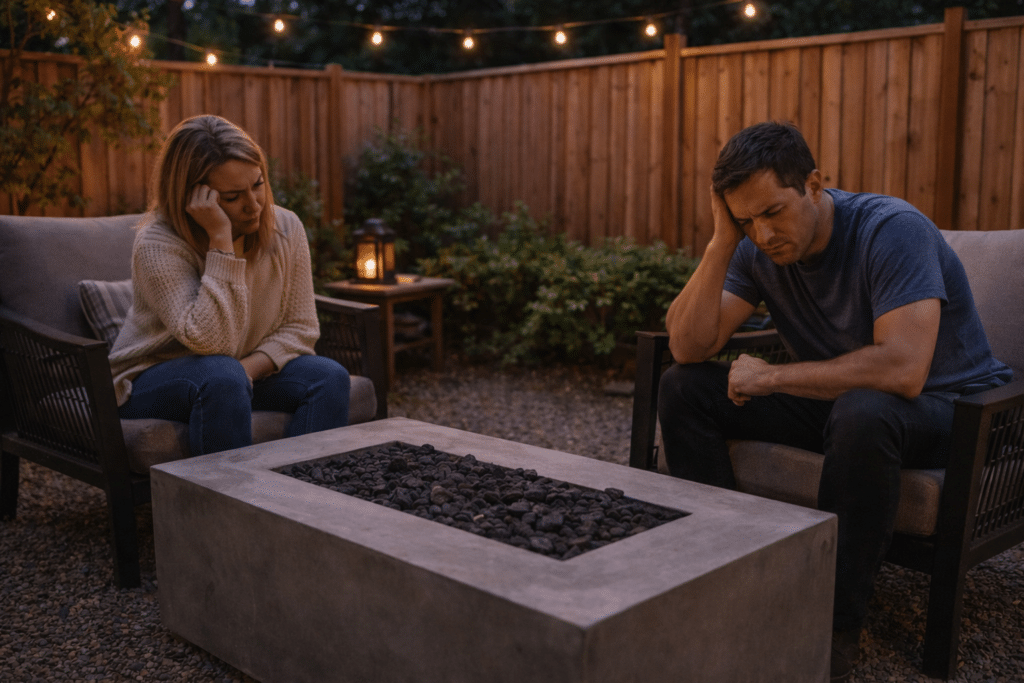
Most people don’t think about regret when they’re choosing a fire table. They think about how it’s going to look, where it’s going to sit, and how nice it’ll be to have people gathered around it. The regret usually shows up later — not because they chose something “bad,” but because they didn’t realize what actually matters until they started using it.
Here are the most common things people get wrong, and what to think about before you buy.
They Chose Wood Because It Felt More “Authentic”
A wood-burning fire has an undeniable appeal. The smell, the sound, the ritual of building it up from scratch — it’s a specific experience that some people love and will never give up. But a lot of buyers come to wood-burning fire features expecting that experience every night, and what they actually get is smoke management.
Smoke follows people. It shifts with any breeze, targets wherever you’re sitting, and in an enclosed patio or a space with limited airflow, it can make the entire area uncomfortable within minutes. After a few seasons of constantly repositioning chairs and coming inside smelling like a campfire on a Tuesday night, a lot of people make the switch to gas.
Gas fire tables burn clean. No smoke, no ash, no smell. You turn them on with a dial and off the same way. The fire is there when you want it — not after twenty minutes of kindling and coaxing. For anyone adding a fire feature to a patio, deck, or enclosed outdoor space, gas is almost always the more practical long-term choice.
They Bought Too Small
This is the most common sizing mistake. People see a 36″ fire table, think it looks like a reasonable size, order it, and then stand next to it in their actual yard and realize it’s not doing what they hoped.
A fire table that’s too small for the space disappears into it. It doesn’t anchor the seating area. It doesn’t draw people toward it. It sits there looking like something that belongs on a balcony, not as the centerpiece of a 400-square-foot patio with six chairs around it.
The right size depends on your specific layout, but for most standard outdoor seating groups, something in the 48″–60″ range hits the right balance. Larger open spaces can go bigger. Smaller intimate patios may do well with 36″–42″. If you’re not sure, err larger — a fire table that’s slightly bigger than you expected reads as intentional and commanding. One that’s slightly smaller reads as an afterthought.
They Didn’t Think About Placement
A fire table doesn’t exist in isolation. It’s part of a layout, and where it sits affects everything: how heat moves through the space, how airflow behaves around it, how naturally people gather near it, and whether the seating arrangement around it actually works.
Common placement mistakes include putting it too close to a fence or wall (which traps heat and limits airflow), setting it in a corner because it “fits there” rather than where people actually sit, and placing it on an uneven surface without leveling the area first.
The rule is simple: put it where people already tend to gather. If your outdoor seating area has a natural center, that’s where the fire table belongs. If it doesn’t have a natural center, the fire table can create one — but only if it’s placed intentionally, not just wherever there’s room.
They Bought Something Built to a Price Point
Fire tables sold at big box stores and online marketplaces are built to hit a number. That means thinner materials, lower-grade burner components, and finishes designed to photograph well rather than hold up year after year. Some of them look great for a season or two. After that, the surface starts to show wear, the burner loses consistency, and the whole thing starts to feel like it was temporary from the beginning.
The buyers who end up replacing a fire table after two or three years almost universally say the same thing: they wish they’d spent more upfront on something that would last. A well-built GFRC concrete fire table doesn’t look like it’s wearing out. It looks better with age, develops a surface character over time, and handles outdoor conditions without the maintenance anxiety that comes with thinner materials.
They Chose Based on the Photo
Fire tables look similar in photos. Clean lines, neutral finish, flame in the middle. The differences that matter — weight, surface texture, structural solidity, flame quality — don’t show up in a product image. They show up when you’re standing next to the thing.
Tap the top of a cheap fire table and a quality one. The difference in sound and feel is immediate. Press down on the surface. Try to nudge the base. Those physical details tell you more about build quality than any spec sheet.
If you can see one in person before you buy, do it. If you’re buying online, look carefully at lead time — a fire table that ships in two days was sitting in a warehouse. One with a 4–6 week lead time was built for you. That’s a meaningful distinction.
They Didn’t Think About How Often They’d Actually Use It
The best fire table is the one you use on a random Wednesday night, not just when company’s coming. That means it has to be easy to start, comfortable to sit around, low-maintenance, and integrated into the space in a way that doesn’t require any setup or effort.
If there’s friction — if starting it is a process, if the smoke makes you move chairs around, if the flame is underwhelming — you’ll use it less. Over time, it becomes something that’s there for guests, not part of the daily routine. And most people buying a fire table are hoping it becomes part of the routine.
The fire tables that get used consistently are the ones that feel effortless: a gas source, a good burner, the right size for the space, and a build quality that doesn’t require babying. Get those things right and you won’t think about the fire table much — you’ll just end up outside more often than you planned.
If You Have Questions, Ask Before You Buy
Castin Crete Designs builds GFRC concrete fire tables to order in Hartland, WI. Every table is custom-built in the size, finish, and fuel configuration you choose. If you want to talk through what would work in your space before committing to anything, give us a call at (262) 501-9966 — we’ve helped a lot of people avoid the mistakes above, and we’re happy to do the same for you.
Browse the collection or visit the showroom in Hartland. No pressure, just a conversation about what makes sense for your space.



No comment yet, add your voice below!