
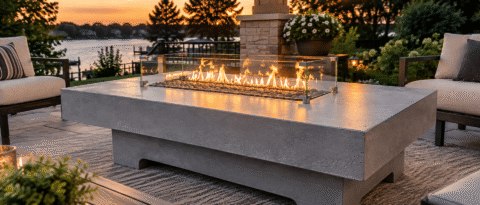
When you’re shopping for a concrete fire table, most of what you see is the finished surface: the shape, color, texture, flame and overall design.
Some of the most important parts of the fire table, however, are things you’ll never see.
Reinforcement is one of them.
A well-built concrete fire table isn’t simply concrete poured into a mold with a burner dropped into the middle. Modern GFRC—glass fiber reinforced concrete—allows us to engineer the concrete itself differently, using high-performance mix designs, specialized admixtures and alkali-resistant glass fibers to create a strong, durable structure without relying on the heavy steel reinforcement associated with conventional concrete.
At Castin Crete Designs, reinforcement is part of the design of the fire table from the beginning.
Here’s what that means—and what you should know before buying a concrete fire table.
Why Does a Concrete Fire Table Need Reinforcement?
Concrete is naturally very strong under compression. Where reinforcement becomes important is in helping concrete withstand tensile and flexural stresses—forces that can try to pull or bend a concrete structure.
That’s particularly relevant to fire tables.
Unlike a slab sitting continuously on the ground, a fire table contains vertical walls, horizontal surfaces, corners and a large opening for the burner system. Depending on its dimensions, portions of the top can effectively span between supporting walls.
Then the table goes outside.
It experiences heating and cooling, changing temperatures and seasonal weather conditions while supporting its own weight year after year.
That’s why we don’t treat reinforcement as an optional addition.
It’s part of the structure.
What Is GFRC?
GFRC stands for glass fiber reinforced concrete. It is a cementitious concrete composite reinforced with alkali-resistant glass fibers that add tensile and flexural strength to the concrete matrix.
Instead of depending exclusively on steel reinforcement inside a thick section of conventional concrete, GFRC distributes reinforcing fibers throughout the material.
That changes what concrete can do.
GFRC has been used for decades in architectural panels, fireplace surrounds, countertops, furniture and other applications where strength, shape and reduced section thickness are important. Concrete Network notes that GFRC’s internal glass reinforcement allows substantially thinner sections than conventional concrete while maintaining strength.
That’s one of the reasons it’s so well suited to architectural fire tables.
Why Do We Use AR Glass Fiber?
The “AR” in AR glass stands for alkali resistant.
That’s important because Portland-cement-based concrete is highly alkaline. Ordinary glass fibers aren’t appropriate reinforcement for long-term exposure inside that environment.
Modern AR glass was specifically developed to withstand the alkaline environment of concrete.
At Castin Crete Designs, AR glass fibers are our primary fiber reinforcement.
They’re not simply tiny individual fibers tossed into the mix to control surface shrinkage. The fibers we use are bundled strands containing multiple filaments. When properly incorporated into the concrete matrix, they help the composite resist tensile and flexural stresses.
Concrete Network describes high-integrity AR strands used in architectural GFRC as containing numerous individual filaments and identifies AR glass as a high-tensile-strength reinforcement.
Professional GFRC material suppliers recognize fiber selection as a critical variable in high-performance mix design, identifying AR glass bundles as one of the principal reinforcement options for GFRC and SCC-style mixes.
But the fibers are only one part of the system.
Good GFRC Starts With the Mix
You can’t take an ordinary concrete recipe, throw glass fibers into it and assume you’ve created high-performance GFRC.
The entire mix has to work together.
Depending on the fire table we’re building, Castin Crete Designs uses different high-performance concrete systems. We work with professional GFRC materials and admixture systems selected for each application, and we individually batch our mixes for the particular requirements of each build.
Modern admixture technology is particularly important.
High-range water reducers and plasticizers allow concrete to achieve the workability and flow characteristics needed for casting without relying on excessive water.
That’s significant because water isn’t simply an ingredient you can keep adding without consequence.
The water-to-cementitious-material ratio influences the concrete’s pore structure, strength, shrinkage and other performance characteristics. Modern GFRC mix designs therefore carefully balance water, cementitious materials, aggregate, fibers and admixtures.
Current GFRC guidance specifically includes high-range water reducers such as polycarboxylate superplasticizers as part of modern pourable GFRC systems.
More Reinforcement Isn’t Automatically Better
This is one of the misconceptions about fiber-reinforced concrete.
If some fiber is good, wouldn’t more fiber be better?
No.
Fiber type, fiber length, loading and mix rheology have to work together.
Too much fiber—or the wrong fiber for a particular mix—can dramatically reduce flowability and make proper consolidation more difficult. Industry documentation shows examples where inappropriate fiber loading changed an otherwise flowing GFRC mix into a thick, poorly flowing material.
That’s why we don’t use one universal recipe for every Castin Crete Designs fire table.
Different shapes, dimensions and casting requirements can call for different approaches.
The objective isn’t to put as much reinforcement into the concrete as possible.
The objective is to put the right reinforcement in the right concrete, in the right places.
What About Scrim and Fiberglass Reinforcement?
AR glass fibers distributed throughout the concrete aren’t the only reinforcement available to us.
Depending on the size and geometry of a particular fire table, Castin Crete Designs may also incorporate AR glass scrim or fiberglass reinforcement.
Scrim is essentially a continuous glass-fiber grid embedded within the concrete composite.
Unlike dispersed chopped fibers, scrim can be strategically positioned where additional reinforcement is beneficial.
AR glass scrim provides continuous interwoven fiber reinforcement for use alongside chopped-strand GFRC. When positioned in tensile regions, the scrim can substantially increase the composite’s flexural strength.
We use it selectively rather than automatically.
Again, the design of the table determines the reinforcement strategy.
Why Don’t We Normally Use Steel?
Traditional concrete construction often uses steel rebar or welded wire reinforcement.
That’s appropriate for many concrete applications.
But architectural GFRC gives us other options.
One advantage of glass reinforcement is that it doesn’t have the corrosion concerns associated with embedded steel. That’s particularly useful when manufacturing relatively thin architectural concrete sections. Concrete Network likewise notes that conventional rebar can be problematic in thin concrete sections because adequate concrete cover is required and improperly sized reinforcement can contribute to cracking.
Castin Crete Designs can use steel when a particular structural requirement calls for it, but we rarely need it in our typical fire-table construction.
Instead, we primarily rely on the GFRC composite itself, AR glass fiber, and additional noncorrosive reinforcement where appropriate.
The Burner Opening Deserves Special Attention
This may be the most important part of this article.
Look at the top of a fire table.
If there were no burner, you could theoretically have one continuous concrete surface.
Now cut a large rectangular, square or round opening through the middle.
You’ve changed the structure.
The areas surrounding that opening have to transfer stresses around the interruption, and they’re also the portions of the table closest to the burner system.
We consider the burner opening a critical reinforcement area.
Castin Crete Designs uses additional reinforcement techniques around our burner openings specifically to help the structure resist cracking and perform over time.
We’re intentionally not publishing the details of how we accomplish that.
Those techniques were developed through our own manufacturing experience, and they’re part of how we build our fire tables.
But the principle itself isn’t a secret:
A fire table should be engineered as a fire table—not as an ordinary piece of concrete that happens to have a hole cut in the middle.
That’s one of the most important questions you can ask when comparing manufacturers:
How is the concrete surrounding the burner opening reinforced?
If the answer is simply “there’s fiber in the concrete,” keep asking questions.
Thickness Is Part of the Structure
Reinforcement can’t be considered independently from the geometry of the table.
At Castin Crete Designs, our typical vertical walls are approximately 3/4 inch thick.
Our horizontal top surfaces are considerably more substantial—typically approximately 1 1/4 to 1 1/2 inches thick, depending on the dimensions and structural requirements of the table.
We aren’t trying to make our fire tables as thin as GFRC will technically allow.
GFRC makes thinner architectural sections possible—Concrete Network cites sections as thin as approximately 3/4 inch for certain countertop applications—but “possible” and “appropriate for this particular fire table” aren’t the same thing.
Our dimensions are selected according to the product we’re building.
Reinforcement Doesn’t End When Casting Is Finished
This is another area where discussions about GFRC often become too focused on fibers.
A great reinforcement system can’t compensate for poor manufacturing practices elsewhere.
Curing and hydration are critical to the finished concrete.
After casting, cement hydration continues as the concrete develops its properties. We tightly control that process because the concrete needs the proper environment to develop the performance the mix was designed to provide.
For us, curing isn’t simply waiting until the concrete is hard enough to strip from the mold.
It’s part of manufacturing the fire table.
Mix design, water control, admixtures, fiber reinforcement, structural geometry and curing all work together.
Remove one of those pieces and you’re no longer evaluating the same product.
Can You See Good Reinforcement in a Finished Fire Table?
Usually not.
That’s what makes comparison shopping difficult.
Once a table has been finished and sealed, you generally can’t look at a photograph and determine:
- what AR glass fiber was used,
- how much reinforcement is in the concrete,
- whether scrim was strategically incorporated,
- whether the burner opening received additional reinforcement,
- whether excessive water was used,
- how the concrete was cured, or
- whether the structure was designed specifically for its dimensions.
A beautifully photographed fire table can tell you whether you like its design.
It can’t tell you how it was built.
What Should You Ask Before Buying a GFRC Fire Table?
If you’re comparing concrete fire tables, ask more than whether they’re made from GFRC. Ask:
- What type of fiber reinforcement do you use?
- Is it alkali-resistant glass specifically designed for cementitious concrete?
- Do you use additional reinforcement such as scrim or fiberglass where necessary?
- How do you reinforce the burner opening?
- How thick are the walls and top?
- Does the reinforcement strategy change with the size and design of the fire table?
- How do you control the water content of the mix?
- How is the concrete cured after casting?
Those questions get much closer to determining what you’re actually buying.
Not All GFRC Fire Tables Are Built the Same
Calling something “GFRC” tells you something about the material.
It doesn’t tell you everything about the fire table.
The performance of the finished product depends on the entire system: mix design, water control, admixtures, fiber selection, fiber loading, supplemental reinforcement, structural dimensions, reinforcement around critical areas and curing.
At Castin Crete Designs, we’ve refined those pieces through years of actually building fire tables and watching them live outdoors through Wisconsin winters, summer heat, rain, snow and hail.
Some of our oldest fire tables have now spent approximately five years outdoors without being covered or protected from the weather and remain in excellent condition.
That’s ultimately the standard that matters to us.
Not simply whether a fire table looks good when it comes out of the mold.
It’s how that table performs after years of gathering people around the fire.
Want to see what that looks like in practice? Read our Delafield custom fire table case study, or learn more about why high-end fire tables cost more.

