


Most people don’t struggle with wanting a fire feature. They struggle with everything that comes after that. Will this fill my space with smoke? Is it safe near fencing or on a smaller patio? What if I pick the wrong type altogether?
If you’ve been searching for answers, you’ve probably come across everything from wood-burning fire pits to gas fire tables, smokeless options, and portable setups — but very little that actually explains what works in a real outdoor space. Most advice online assumes you already understand the basics. The reality is your space, layout, and how you plan to use it matter far more than most buying guides let on.
Start With Your Space, Not the Product
Before you look at a single product, look at where you want to put it. The size and layout of your outdoor space will determine more about what works than any feature list will.
Smaller patios, gravel surfaces, and enclosed areas with fencing all change how fire behaves. Heat reflects differently, airflow is more limited, and smoke doesn’t drift away the same way it would in a wide-open yard. Choosing something that works with your environment is more important than choosing the most popular option.
Think about where people naturally gather when they’re outside. That’s where a fire feature should go — not in a corner because it seemed out of the way, and not centered in the yard if the seating area is against the house. The fire feature should anchor the space people are already in, not create a new destination they have to walk to.
Wood or Gas — Here’s the Honest Version
Wood-burning fires have a traditional appeal that’s hard to argue with. The sound, the smell, the ritual of building a fire — there’s something to it. But in tighter or more contained outdoor spaces, smoke is almost always the first problem that makes people regret the choice.
Smoke follows people. It shifts with the breeze, follows seating positions, gets into clothes, and in a smaller enclosed space it can make the entire area uncomfortable. Some people are willing to deal with that because they love the wood-fire experience. Others try it for a season and wish they’d gone a different direction from the start.
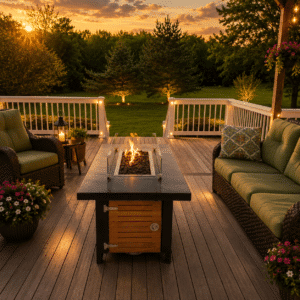
Gas fire features — propane or natural gas — burn completely clean. No smoke, no ash, no smell that lingers in cushions and clothing. You can sit closer to the flame without worrying about a wind shift ruining the evening. You can put a gas fire table on a deck or patio closer to the house or fencing without the smoke concerns that come with wood. It turns on in seconds and turns off the same way.
For most people adding a fire feature to an existing patio or deck, gas is the more practical choice — especially if the space is enclosed or the neighbors are close.
Fire Table vs. Fire Pit: What’s the Difference?
A lot of people use these terms interchangeably, and that’s fine — the line between them is blurry. Generally, a fire pit is lower to the ground and often bowl-shaped, while a fire table is table-height and functions as both a heat source and a surface you can set things on.
For most outdoor seating setups, a fire table is the more functional choice. It integrates naturally into a seating arrangement without requiring people to hunch forward to feel the heat. The surface can hold drinks, small plates, or simply act as the visual and physical center of the space.
Fire bowls sit lower and have more of a sculptural, decorative presence. They work beautifuly as standalone accent pieces or in larger open spaces where the lower profile fits the aesthetic.
Browse our concrete fire table collection or see our fire bowls to get a sense of the range.
Propane or Natural Gas?
If you’re going gas, the next question is which kind. Propane is the easier starting point — you connect a standard tank, no permanent line required, and you can place the fire table anywhere. If you ever rearrange the patio or move to a new house, it comes with you.
Natural gas costs less to run over time and means you never have to swap tanks. It does require a permanent gas line, which needs to be installed by a licensed professional. If you’re building or remodeling an outdoor space, it’s worth planning for it during construction. If you’re working with an existing patio, propane is usually the simpler path.
Sizing: Bigger Isn’t Always Better
The most common sizing mistake is going too small. A fire table that’s proportionally right for a seating area feels like the anchor of the space. One that’s too small feels like an afterthought — technically a fire table, but not commanding enough to draw people in.
Going too large is less common but equally disruptive. An oversized fire table closes off the space and makes moving around it feel awkward.
A good rule of thumb: the fire table should be roughly proportional to the seating arrangement around it. For a standard four- to six-person outdoor seating group, something in the 48″–60″ range usually hits the right balance. Larger groups and more open spaces can go bigger. Intimate patios and smaller decks often do better with a 36″ or 42″ option.
What to Look for in the Build
Outdoor fire features take a lot of abuse. Sun, rain, Wisconsin winters, freeze-thaw cycles, and regular use will expose any weaknesses in materials fairly quickly.
GFRC concrete holds up better than most alternatives. It doesn’t warp, rust, or fade the same way metal and resin surfaces do. It’s also naturally resistant to heat and moisture, which matters when you’re building something meant to be outside year-round and used around an open flame.
Whatever you’re looking at, pay attention to how the top and base are constructed. A solid fire table doesn’t flex when you press on the surface and doesn’t shift when you nudge it. Those aren’t just comfort details — they’re signs of how the piece will hold up over time.
Still Not Sure? That’s Normal.
Most people who haven’t owned a fire feature before don’t know exactly what they want until they see a few options in person. That’s why we always recommend coming by the showroom if you’re anywhere near Lake Country — it’s a lot easier to understand what a fire table actually feels like when you’re standing next to one.
Castin Crete Designs is located in Hartland, WI, just minutes from Delafield, Oconomowoc, Waukesha, and the greater Milwaukee area. Every piece is built to order, so you’re not choosing from a warehouse — you’re choosing what gets built for you.
Visit our showroom, browse the collection online, or call us at (262) 501-9966. If you’re not sure where to start, we’ll help you figure it out.

No comment yet, add your voice below!