
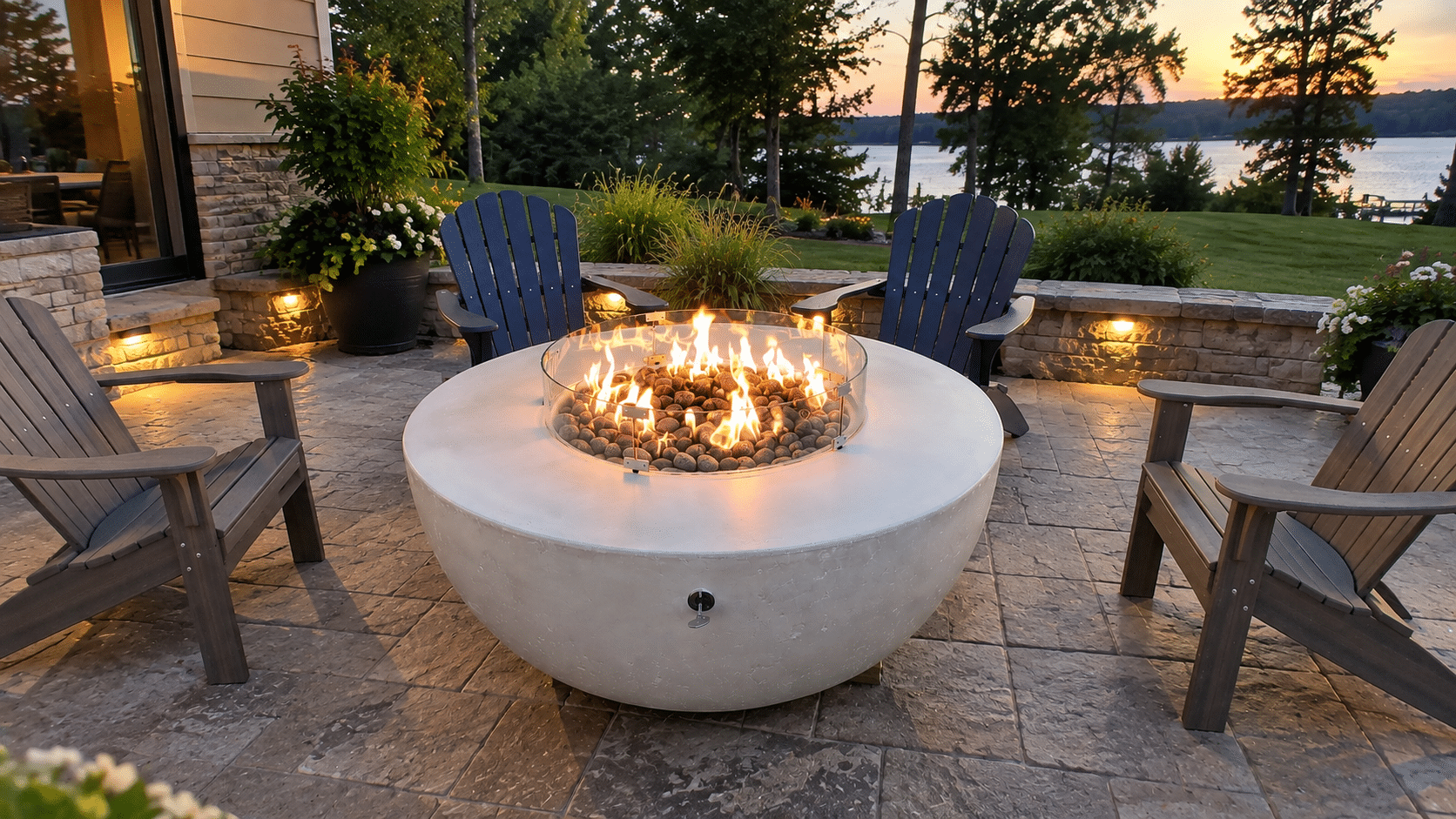
There isn’t one correct fire-table size for a particular patio.
A 48-inch table might be perfect for one space and feel too small in another patio with exactly the same dimensions. A 60-inch table might technically fit but leave the seating area cramped. Or a smaller table might fit six chairs, but put everyone much closer together than you actually want.
That’s because the size of your patio is only one part of the decision.
You also need to consider the size and style of your furniture, how many people you want around the fire, how much room you want between them, what you plan to put on the tabletop, the size of the burner opening and whether you’re adding a wind guard.
A better question is:
What size fire table works with the way you actually want to use your outdoor space?
Here’s how to figure that out.
Start With Your Seating Area, Not Just Your Patio Size
The first measurement we would want isn’t necessarily the total size of your patio.
It’s the portion of the patio you’re actually dedicating to the fire table and seating.
A 20-by-20-foot patio doesn’t give you 400 square feet for a fire-table arrangement if part of that space contains an outdoor kitchen, grill, stairs, columns, doors, planters or a walkway to the backyard.
Determine the actual area available for the seating group.
Then measure the furniture.
This matters more than many people realize.
A deep outdoor lounge chair can take up considerably more room than a conventional upright patio chair. Adirondack-style chairs, reclining chairs and sectionals create different footprints again.
If you already own your furniture, measure it.
Don’t estimate.
Measure the chair from front to back and look at where your feet and knees actually end up when you’re sitting in it.
You’re not trying to determine whether an empty chair fits around the fire table.
You’re trying to determine whether a person sitting in that chair fits comfortably around the fire table.
How Many People Do You Want Around the Fire?
This sounds like a simple question.
It isn’t.
Let’s say you want seating for six.
Do you want six people sitting relatively close together in a cozy conversation area?
Or do you want six chairs with noticeable open space between them?
Those two arrangements can require very different table sizes.
We recently built a 62-inch Zen fire table for customers who wanted six chairs surrounding the table with open space between the chairs.
The 62-inch size worked very well for what they wanted. There was enough circumference to comfortably distribute the six chairs without making the arrangement feel crowded.
They could have gone down to a Zen in approximately the 48- to 50-inch range.
Six chairs could potentially still be arranged around it, depending on the chairs.
But it would be a different seating area.
The chairs would be closer together and the entire group would feel more intimate.
Neither arrangement is necessarily better.
It depends on what you want.
That’s why a chart that simply says “four people need this size” and “six people need that size” can only take you so far.
The dimensions of the chairs and the amount of personal space you want between people matter too.
Think of a Fire Table as Outdoor Furniture
A fire table is obviously a fire feature.
But when you’re deciding what size to buy, it helps to think about it as a piece of furniture too.
Interior designers don’t normally select a coffee or cocktail table simply because it fits somewhere in the room.
They look at its relationship to the seating.
Conventional furniture-design guidance commonly places a coffee table approximately 16 to 18 inches from the sofa and near the height of the seat cushion. Designers also frequently use the length of the sofa as a starting point for determining the proportion of a coffee table.
Those aren’t fire-table safety requirements.
But the underlying design principle is extremely useful:
The table should relate to the people and furniture surrounding it.
It should be close enough to actually use without making the seating feel cramped.
It should be visually proportional to the furniture.
And there should still be enough room to comfortably sit down, stand up and move through the space.
How Much Room Should You Leave Between a Fire Table and the Seating?
This is one area where we don’t like giving homeowners a single magic number.
Furniture-design guidance frequently starts around 16 to 18 inches between a coffee table and sofa because that tends to provide enough knee room while keeping the tabletop within reach.
Fire-table recommendations you’ll find online vary considerably, often suggesting larger distances depending on the fire feature, furniture and heat output.
Those measurements should not be confused with required safety clearances.
Always follow the installation and clearance requirements that apply to the specific fire table and burner system.
From a comfort standpoint, however, there’s a simple test that’s more useful than blindly following a number:
Sit in the actual chair.
We recently did exactly that while evaluating one of our fire tables at Castin Crete Designs.
With an approximately 18-inch-high table, roughly 15 to 16 inches of knee and foot room felt comfortable enough to sit down, stand up and have room for our feet beneath the table.
The person doing the test was also 6’3″.
That’s not an industry standard or a measurement we’re suggesting everyone copy.
It’s an example of why your furniture and your body dimensions matter.
Someone using a deep lounge chair may want something completely different from someone sitting upright in a conventional patio chair.
Don’t Forget the Space Behind the Chairs
The table can fit.
The chairs can fit.
Everyone can sit down comfortably.
And the entire layout can still be wrong.
Why?
Because nobody can walk behind the chairs.
This becomes especially important if the fire-table seating area sits between the house and another frequently used part of the patio.
Think about normal traffic:
Can somebody walk from the house to the grill while people are sitting around the fire?
Can someone carrying drinks get through?
Can a patio door open completely?
Can people enter and leave their chairs without everyone else having to move?
Furniture-design guidance commonly reserves approximately 30 to 36 inches for important walkways when the space allows it. That isn’t a fire-table requirement; it’s simply useful space-planning guidance.
The important point is to measure the entire occupied seating arrangement, not just the fire table.
The Burner Opening Changes How Much Table You Actually Have
This is one of the most important measurements when choosing a fire table, and it’s often overlooked.
The outside dimensions tell you how large the table is.
They don’t tell you how much usable tabletop you’re getting.
The burner opening occupies part of the surface.
And as the burner gets larger, the opening generally gets larger with it.
For example, some of the round burner configurations we use at Castin Crete Designs include:
- A 12-inch stainless-steel burner rated at approximately 92,000 BTUs in an 18-inch burner opening
- An 18-inch burner rated at approximately 147,000 BTUs in a 24-inch burner opening
- A 24-inch burner capable of approximately 300,000 BTUs in a 30-inch burner opening
Look at what happens there.
Going from an 18-inch burner opening to a 30-inch opening adds 12 inches to the diameter occupied by the fire area.
If the outside dimensions of the table don’t increase along with it, you’re giving up usable tabletop.
That’s why we think buyers should ask for two measurements, not one:
What are the outside dimensions of the fire table?
And:
What are the dimensions of the burner opening?
If you’re planning to use the surface as an actual table, the relationship between those measurements can be just as important as the overall size.
How Much Usable Tabletop Do You Need?
This is where the answer becomes very personal.
We recently spent quite a bit of time discussing this exact question with a couple choosing their fire table.
Their configuration left approximately seven inches of tabletop between the burner opening and the outside edge.
Was that enough?
For what they wanted, we thought it was.
Seven inches gives you useful surface for beverages, a wine glass, beer bottle, soda can and other smaller items. Depending on what you’re placing there, it may also accommodate small dessert or cocktail plates.
It also provides usable surface if you’re someone who likes putting your feet up around the fire.
But maybe that’s not how you’re going to use your table.
If you regularly entertain and want room for appetizers, cocktail plates or larger dishes, something closer to 10 or 12 inches of usable tabletop may be much more attractive.
Other fire-table design guidance similarly discusses ledges in roughly this general range, with the required surface depending on whether the goal is simply holding drinks or providing a more functional tabletop.
There isn’t one correct number.
Instead, ask:
What am I actually going to put on this table?
If the answer is mostly drinks, you don’t necessarily need an enormous tabletop.
If you envision food, plates and entertaining, additional surface becomes much more valuable.
And if the fire and conversation are the priority and you rarely put anything on the table, you may prefer putting more of the available space toward the fire.
That’s a decision worth making before the table is built.
Don’t Forget the Wind Guard
If you’re adding a glass wind guard, include it in the tabletop calculation.
A wind guard surrounds the burner opening and helps keep the flame more stable when wind moves across the table.
But the glass and its mounting hardware also occupy part of the tabletop.
So if you have seven inches between the burner opening and the edge of the table, you shouldn’t automatically assume that all seven inches will remain completely usable after the wind guard is installed.
Ask for the complete wind-guard footprint.
This becomes increasingly important with larger burner openings because you’re already dedicating more of the tabletop to the fire.
A wind guard can also help keep wind from pushing the flame toward beverages and other items on the table and provides additional physical separation from the flame.
But don’t treat the glass as a guarantee that something placed near an operating fire cannot become warm.
It’s still a fire.
What Height Should a Fire Table Be?
For lounge and conversation-style fire tables, approximately 18 inches is a height we particularly like at Castin Crete Designs.
Interestingly, that’s also very close to conventional coffee-table proportions.
Furniture designers commonly work with coffee and cocktail tables around 16 to 18 inches high, generally keeping the tabletop near the height of the seating cushion.
Again, a fire table isn’t an indoor coffee table.
But human ergonomics don’t suddenly disappear when the furniture moves outside.
An approximately 18-inch fire table pairs naturally with many outdoor lounge chairs and sofas. It keeps the surface accessible and the fire at a comfortable visual level.
But your furniture still matters.
Very low modern lounge furniture may pair better with something lower.
Taller furniture may change what feels natural.
And if your primary goal is eating complete meals at the table, you’re moving into a different category entirely: a dining-height fire table.
Don’t choose the table height without looking at the seat height of the furniture surrounding it.
Round, Square or Rectangular?
Size isn’t just a measurement.
Shape changes how the same amount of space functions.
Round Fire Tables
Round fire tables work particularly well when chairs surround the fire from several directions.
They naturally create a conversation area and eliminate corners, which can also be helpful when people need to move around the table.
Square Fire Tables
Square tables work well with symmetrical seating arrangements and patios with strong square or rectangular architectural lines.
Four-chair arrangements are particularly natural around a square table, although larger square tables can accommodate considerably more seating.
Rectangular Fire Tables
Rectangular tables work especially well with sofas and sectionals.
A sofa on one side with two or three chairs opposite naturally creates a rectangular seating area.
They’re also useful on long patios where a large round or square table would consume too much depth.
This is where conventional furniture-design thinking can be helpful.
Designers frequently size coffee tables in relation to the sofa rather than the entire room. A common starting point is somewhere around one-half to two-thirds of the sofa’s length.
We wouldn’t turn that into a fire-table rule.
But the principle is worth borrowing:
Let the seating arrangement help determine the proportions of the table.
Bigger Isn’t Necessarily Better
A large fire table can look spectacular.
That doesn’t mean you need one.
If a 60-inch table forces chairs into walkways or leaves the entire patio feeling crowded, the fact that it technically fits doesn’t make it the right size.
The opposite can happen too.
A small fire table placed in the middle of a large sectional arrangement can look undersized and leave people sitting at the ends too far away to comfortably use the tabletop.
This is where intended use matters again.
Do you want:
- A compact conversation area?
- A dramatic centerpiece?
- Six people sitting close together?
- Six people with open space between their chairs?
- A large fire?
- More tabletop?
- Room for appetizers?
- Mostly drinks?
Those questions will tell you more than patio square footage alone.
Tape It Out Before You Order
This may be the easiest way to avoid choosing the wrong size.
Get a roll of painter’s tape.
Mark the outside dimensions of the fire table directly on your patio.
Then position your actual chairs around it.
If you haven’t purchased the furniture yet, look up the dimensions and tape those footprints onto the patio too.
Now sit in the arrangement if you can.
Can you comfortably get up?
Where do your knees go?
Can you reach the tabletop?
Can someone walk behind you?
Can the patio door open?
Now mark the burner opening inside the taped fire table.
If you’re adding a wind guard, mark its approximate footprint too.
That’s when something important usually becomes obvious:
The outside dimensions are only part of the story.
You can even tape out two different sizes — perhaps a 48-inch and 60-inch table — and live with the outlines for a day.
Walk around them.
Bring the chairs out.
Sit down.
The better size often becomes obvious very quickly.
A 60-Second Fire Table Sizing Check
Before choosing a size, answer these questions:
- How much patio space can actually be dedicated to the entire seating area?
- What are the real dimensions of your chairs, sofa or sectional?
- How many people do you normally want around the fire?
- Do you want people sitting relatively close together or with open space between them?
- Can everyone sit down and stand up comfortably?
- Is there adequate room behind occupied chairs for the way people move through the patio?
- What will you actually put on the tabletop — drinks, small plates, appetizers or very little?
- What are the dimensions of the burner opening?
- How much usable tabletop remains around that opening?
- Are you adding a wind guard, and how much surface will it occupy?
- Would a round, square or rectangular table work better with your furniture?
- Is the table height appropriate for your seating?
If you can answer those questions, you’re much closer to knowing what size fire table you actually need.
In Summary: What Size Fire Table Do You Need?
There isn’t a universal answer.
Start with the furniture and the usable portion of your patio, not simply the overall patio dimensions.
Determine how many people you want around the fire and whether you want the seating to feel intimate or open. Then decide how much usable tabletop you want after accounting for the burner opening and, if applicable, the wind guard.
Finally, make sure the entire occupied seating arrangement leaves enough room for people to comfortably sit, stand and move through the patio.
The right fire table isn’t necessarily the biggest one that fits.
It’s the one that fits the way you want to use the space.
Frequently Asked Questions About Fire Table Size
Is Seven Inches of Tabletop Around a Fire Table Enough?
For many people, yes.
Approximately seven inches can provide useful room for drinks, smaller items and potentially small plates. If you want to regularly serve appetizers, use larger plates or treat the fire table more like a conventional cocktail table, you may prefer a wider surface.
Remember to account for the space occupied by a wind guard if you’re adding one.
How Far Should Chairs Be From a Fire Table?
There isn’t one measurement that applies to every fire table, chair and burner configuration.
From a furniture-layout standpoint, approximately 16 to 18 inches is commonly used between conventional coffee tables and seating because it provides a balance between reach and knee room.
A fire table adds heat and appliance-clearance considerations, however, so furniture-design guidance should never replace the installation requirements for the particular fire table and burner system.
How Many People Can Sit Around a 60-Inch Fire Table?
It depends heavily on the shape and size of the chairs.
Six compact chairs and six large outdoor lounge chairs require very different amounts of space.
A table around 60 inches can work very well for larger seating groups, but don’t determine seating capacity from the table dimension alone. Measure the actual furniture and decide how much open space you want between people.
Is an 18-Inch Fire Table a Good Height?
Approximately 18 inches works very well with many lounge-style outdoor seating arrangements and is a height we commonly like at Castin Crete Designs.
Compare it with your actual seat height before deciding. Low-profile furniture, taller chairs and dining applications can call for different table heights.
Does a Wind Guard Reduce Usable Tabletop Space?
Yes.
A wind guard and its mounting hardware occupy some of the surface around the burner opening.
If tabletop space is important to you, determine the complete wind-guard footprint before deciding whether the table provides enough usable surface.
Choosing a Fire Table Around Your Space
One of the advantages of a made-to-order fire table is that you don’t necessarily have to force your outdoor space around predetermined dimensions.
Table size, shape, height, burner opening, burner output and usable tabletop can all be considered together.
At Castin Crete Designs, that’s often how the sizing conversation begins.
Show us the patio.
Tell us what furniture you’re using.
Tell us how many people you want around the fire and what you actually want to do at the table.
From there, it’s much easier to determine which dimensions and burner configuration make sense before the table is built.
Explore our fire tables collection, or get in touch to start the conversation.


No comment yet, add your voice below!