
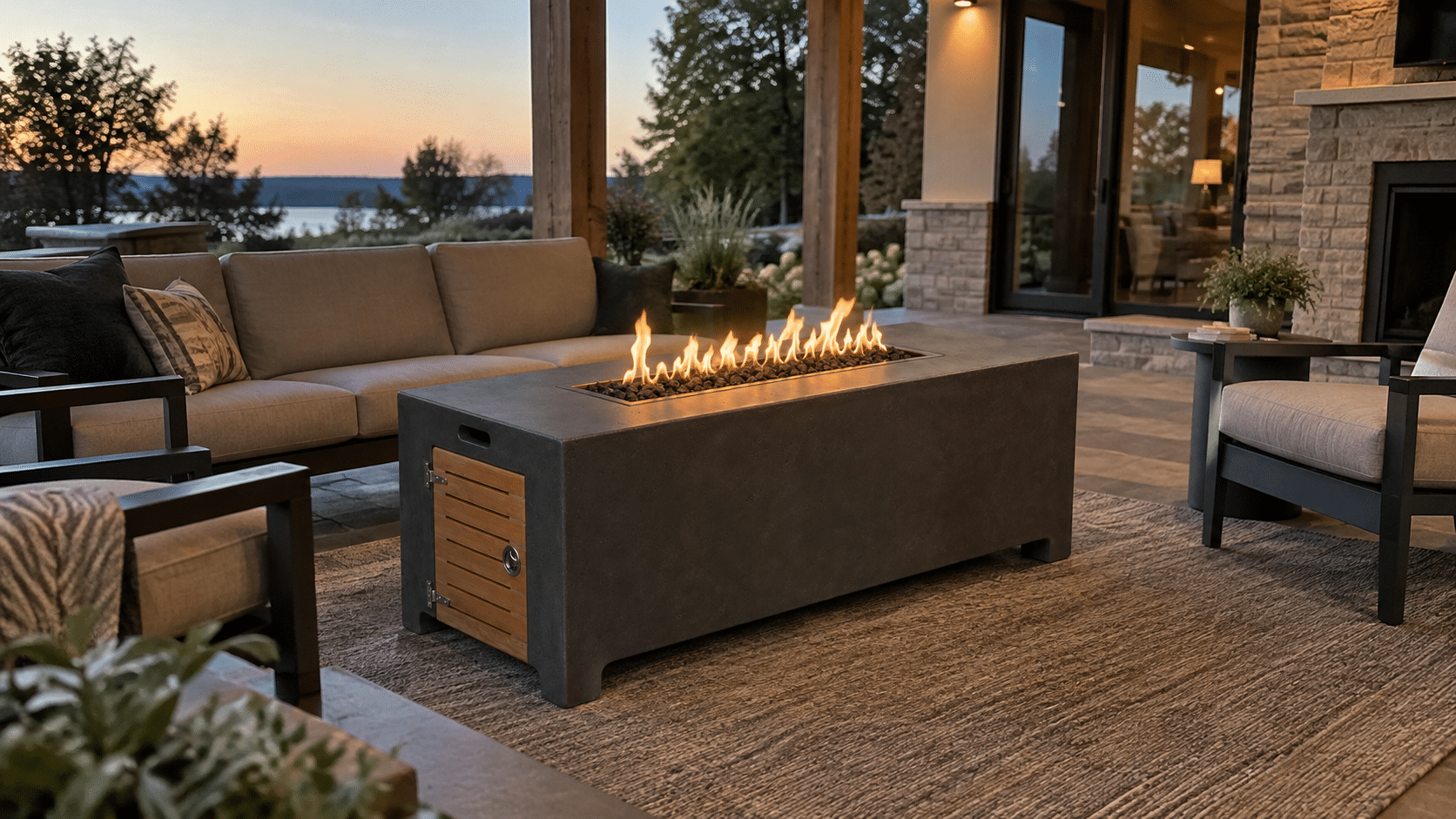

Yes, in many cases you can use a gas fire table under a covered patio. But the fact that your patio has a roof — or even a high roof — isn’t enough by itself to determine whether a particular fire table is appropriate for the space.
The fire table has to be designed for outdoor use and suitable for the installation. The patio needs adequate permanent ventilation. You also need enough clearance between the burner and the roof, beams, walls, ceiling fans, lighting and other materials around it.
That’s why the common advice to simply “make sure you have seven feet above the fire” doesn’t tell the whole story.
There isn’t one universal ceiling height that makes every gas fire table safe under every covered patio. A 92,000 BTU fire table and a 300,000 BTU fire table aren’t the same heat source. An open pergola and a solid-roof pavilion aren’t the same environment either.
If you’re thinking about putting a fire table under a covered patio, here’s what you should actually look at.
Start With the Fire Table, Not Just the Patio
One of the easiest mistakes to make is measuring the patio first.
A homeowner sees a nine- or ten-foot ceiling and assumes there’s plenty of room for a fire table. But the better place to start is with the specific fire table and burner system you’re considering.
Outdoor decorative gas appliances are covered by standards such as ANSI Z21.97/CSA 2.41. The important point for the homeowner is fairly simple: the installation and clearance requirements that apply to the specific appliance matter.
There is no universal “7-foot rule” that overrides those requirements.
Published installation requirements can vary considerably from one outdoor gas appliance to another. That’s why we wouldn’t tell someone that an 84-inch ceiling automatically makes a covered patio suitable for any gas fire table.
Before deciding whether a particular table will work, determine what its installation requirements are and compare those requirements with the actual space where you intend to put it.
How Much Ceiling Clearance Do You Need Above a Fire Table?
This is usually the first question people ask, but there isn’t one number that applies to every fire table.
You’ll frequently see 84 inches, or seven feet, recommended online as a general minimum. That may be sufficient for some installations. It isn’t a universal clearance requirement for every burner or fire table.
The proper measurement also isn’t necessarily the height of your patio ceiling.
Look for the lowest overhead obstruction above or near the fire. That could be:
- A structural beam
- A wood rafter
- A ceiling fan
- A hanging light
- A retractable awning
- A fabric shade
- A vinyl or composite soffit
- The lower edge of the roof
- A decorative ceiling feature
If a beam hangs a foot below a ten-foot ceiling, the ten-foot ceiling isn’t the measurement that matters. The beam may be.
The same goes for a ceiling fan. Besides occupying overhead space, a running fan can change the movement of the flame and the hot air rising from it.
Measure the space the fire will actually occupy, not simply the room dimensions shown on a set of plans.
BTUs Matter, but They Don’t Create a Simple Clearance Formula
This is another place where online advice tends to become oversimplified.
BTU is the burner’s maximum heat-input rating. It tells you something important about the potential output of the fire, but it doesn’t give you a formula for determining safe ceiling clearance.
You can’t simply say that X number of BTUs requires X feet of clearance.
Burner design, flame pattern, burner opening, enclosure design, gas pressure, wind and the installation itself all affect how a fire behaves. The applicable installation requirements still control.
But burner output absolutely deserves consideration when you’re designing a covered outdoor space.
At Castin Crete Designs, for example, we build fire tables using several very different burner configurations.
A smaller round configuration can use a 12-inch stainless steel burner rated at approximately 92,000 BTUs. A larger round configuration can use an 18-inch burner rated at approximately 147,000 BTUs. Our larger 24-inch round burner is capable of approximately 300,000 BTUs.
Rectangular tables can be just as different. One of our standard configurations uses an H-style burner in a 30-by-10-inch burner opening at approximately 125,000 BTUs. Larger rectangular configurations can use a 48-inch H-style burner capable of approximately 300,000 BTUs.
Those aren’t interchangeable fires.
A homeowner looking at photographs online can easily underestimate how much difference there is between burner configurations.
As burner size and potential output increase, we pay increasingly close attention to the environment surrounding the fire — including the available space, gas supply, overhead structure and how the patio will actually be used.
The lesson isn’t that a particular BTU rating automatically requires a certain ceiling height.
It’s simpler than that:
Choose the fire to fit the space. Don’t choose the largest flame available and then try to make the space accommodate it.
Is a Pergola Different From a Solid Patio Roof?
Yes, potentially quite different.
But even the word “pergola” has become complicated.
A traditional open-slat pergola allows heat and combustion products to escape much more freely overhead than a solid roof. Modern pergolas, however, can include motorized louvers, retractable fabric roofs, screens and side curtains.
A louvered pergola with the louvers completely open isn’t the same environment as that same pergola with the louvers closed.
That’s why the structure should be evaluated in the configuration in which the fire will actually be used.
If closing the louvers, extending an awning or lowering side panels substantially changes the ventilation or overhead environment, don’t assume an installation that works with everything open automatically works when everything is closed.
A Covered Patio Still Needs to Be an Outdoor Space
This may be the most important distinction in the entire discussion.
A roof doesn’t necessarily make an outdoor area enclosed. But adding walls, screens, windows, curtains and vinyl panels can gradually turn what started as a patio into something very different.
Gas fire tables designed as outdoor appliances need an outdoor environment with adequate permanent ventilation.
You’ve probably seen advice saying a covered patio should have “at least two open sides.” That’s a useful screening question, but we wouldn’t treat it as a universal rule that automatically makes every installation acceptable.
Actual appliance and installation requirements vary.
Instead, ask:
How much of the structure is permanently open?
Where can fresh air enter?
Where can heat and combustion products escape?
Does the specific fire table or appliance permit this type of installation?
A large pavilion with a roof and four completely open sides is obviously different from a room with a roof, three walls and sliding doors — even if both are marketed as “outdoor living spaces.”
What About a Screened Porch or Three-Season Room?
Don’t automatically assume that screen equals open air.
Screens change airflow. Screened structures may also have combustible framing, lower ceilings and less permanent open area than they appear to have.
A three-season room deserves even more caution.
If glass, vinyl windows or panels can be closed, the ventilation characteristics of the space can change dramatically while the fire is operating.
That’s fundamentally different from an open-sided pavilion.
A ceiling fan doesn’t turn an enclosed or inadequately ventilated space into an acceptable outdoor installation.
If you’re reaching the point where you’re debating whether a screened wall, removable panel or partially opened window technically makes the room “outdoors,” that’s a good indication that the installation deserves professional review before purchasing the fire table.
Pay Attention to What’s Above the Flame
Distance isn’t the only issue. Material matters too.
Covered patios can contain:
- Wood framing
- Vinyl soffits
- Composite materials
- Fabric
- Plastic or translucent roofing panels
- Lighting
- Speakers
- TVs and TV mounts
- Electrical wiring
- Curtains
- Ceiling fans
Even when something doesn’t ignite, prolonged exposure to rising heat can potentially discolor, deform or damage heat-sensitive materials.
Look vertically above the burner and outward around it.
The question isn’t simply:
“Can the flame touch this?”
A better question is:
“Where is the heat going after it leaves the flame?”
Don’t Forget About Wind
A covered patio doesn’t necessarily mean a wind-free patio.
Some covered spaces actually create strong crosswinds because air is channeled between the house and the open sides of the structure.
That can push the flame away from the center of the burner.
This affects comfort, but it can also change where the heat from the flame is being directed.
We’ve seen this firsthand on outdoor installations here in Wisconsin. One Castin Crete project in Delafield, for example, used a 147,000 BTU burner with a glass wind guard because the elevated site regularly experiences significant wind.
That’s a Wisconsin example, but it isn’t a Wisconsin problem.
An exposed patio in Arizona, Colorado, Texas or coastal Florida can experience the same thing.
If the patio regularly gets strong crosswinds, account for that when selecting the burner and determining the final location of the fire table.
A properly designed glass wind guard can help stabilize the flame in installations where wind is a recurring problem.
Natural Gas vs. Propane Under a Covered Patio
Both natural gas and propane fire tables can be designed for outdoor use, but the installations aren’t identical.
A permanent natural-gas installation eliminates the need to store a propane cylinder in or around the fire table. For someone already building a permanent covered patio, outdoor kitchen or pavilion, that can make natural gas an attractive option.
It doesn’t automatically make natural gas “safer” for every covered patio, and it doesn’t eliminate the need for proper clearances and ventilation.
A natural-gas installation still requires a properly sized gas supply, accessible shutoff and appropriate final connection.
Propane introduces another consideration: the cylinder itself.
Cylinder location, enclosure design, ventilation and the components used to connect the cylinder to the burner all need to be appropriate for the appliance and installation.
Don’t improvise a propane compartment simply because a 20-pound cylinder physically fits inside the table.
If you’re planning a permanent covered outdoor living space and already have access to natural gas, it’s worth discussing that option during the planning stage rather than automatically defaulting to propane.
Make Sure You Can Shut the Fire Off Easily
This isn’t as interesting as burner size or flame height, but it matters.
The person operating the fire should have convenient access to the controls and gas shutoff intended for the installation.
Don’t design a beautiful outdoor space and then bury the shutoff behind permanent furniture, cabinetry or something else that makes it difficult to reach.
This is especially worth thinking about before construction begins.
If the patio, gas line and fire-table location are being designed at the same time, the gas supply, shutoff location and final connection can all be planned around where the table will actually sit.
The Fire Table Itself Needs Ventilation
This gets overlooked surprisingly often.
Homeowners focus on ventilating the patio, but a gas fire feature may also require ventilation through its enclosure.
Those vents aren’t decorative.
Proper enclosure ventilation can provide necessary airflow and help prevent unburned gas from accumulating inside the table in the event of a leak.
The required amount and location of ventilation depends on the fire-table and burner system.
Never cover enclosure vents with decorative panels or block them with furniture, rugs, landscaping or other objects.
And in cold climates, don’t let snow accumulate around ventilation openings during winter use.
The patio needs to breathe.
So does the fire table.
What About the Surface Under the Fire Table?
Look down as well as up.
Concrete, masonry, stone and appropriately constructed paver patios provide a straightforward environment for many outdoor fire tables.
Wood and composite decks require more attention.
Don’t assume that because the body of a fire table is made from GFRC concrete, the table can automatically be placed on any surface.
Whether a particular fire table can be installed over combustible decking depends on the design and applicable installation requirements.
The answer should come from the fire table’s requirements, not from a generic statement that “gas fire pits are safe on decks.”
Bigger Isn’t Always Better
This is worth emphasizing because it’s something we see from the manufacturing side.
People naturally gravitate toward the largest flame.
We understand why. A large flame makes an impression and can provide considerably more heat.
But the best burner isn’t necessarily the biggest burner.
It’s the one that fits the space, gas supply and intended use.
A 300,000 BTU fire table in a large open outdoor environment can be spectacular. Put that same potential output into a compact covered patio and you may end up with far more fire than the space needs.
Sometimes the answer isn’t a taller roof.
It’s a different burner.
This is also one advantage of planning a made-to-order fire table around the patio rather than trying to make a predetermined mass-market configuration fit.
Table dimensions, burner size, burner opening, fuel type and potential output can all be considered along with the patio geometry.
If you’re designing the patio and fire table at the same time, that’s even better. Decisions that can be difficult after construction are often relatively simple while everything is still on paper.
A 60-Second Covered-Patio Check
Before ordering a fire table, stand where you actually want to put it and answer these questions:
- Is the fire table intended for outdoor use and appropriate for this type of installation?
- What overhead and side clearances apply to the specific appliance?
- What is the lowest object above or near the burner — not simply the ceiling height?
- Is the patio permanently open enough to remain an outdoor environment?
- Are there combustible or heat-sensitive materials above or beside the fire?
- Will a ceiling fan, strong crosswind or other airflow regularly affect the flame?
- Is the table being installed on an appropriate surface?
- If you’re using propane, is the cylinder location and enclosure designed and ventilated correctly?
- If you’re using natural gas, can the gas supply deliver the required BTUs?
- Is the gas shutoff accessible?
- Does the fire-table enclosure have the required ventilation?
- Do the appliance requirements and applicable local requirements allow the installation you’re planning?
If you can’t confidently answer the first four questions, don’t order the fire table yet.
Figure out the installation first.
So, Can You Put a Gas Fire Table Under Your Covered Patio?
Very possibly.
A properly selected gas fire table can work beautifully under many covered patios, pergolas and open-sided pavilions. In fact, a covered outdoor space and a fire table can be an excellent combination because the roof provides shelter while the fire extends the amount of time people actually want to spend outdoors.
But there is no single ceiling-height number, BTU limit or “two open sides” rule that determines every installation.
Look at the entire space.
Look at the patio’s permanent ventilation.
Look at what’s above and around the burner.
Consider wind.
Determine what the specific fire table requires.
Then select a table and burner configuration appropriate for that environment.
If you’re still designing the patio, that’s actually the ideal time to make these decisions. Burner output, table dimensions, gas-line capacity, shutoff location and overhead clearance are much easier to address before construction is complete.
If you’re considering a Castin Crete fire table and aren’t sure which configuration makes sense for your covered patio, send us a few photos along with the patio dimensions and ceiling height. We can help you determine which table size and burner configuration makes sense for the space before you order.
The information in this article is provided for general informational purposes only and does not constitute professional engineering, code compliance, or installation advice. Gas appliance installations are subject to applicable local building codes, gas codes, and fire codes, which vary by jurisdiction. Requirements for your specific installation may differ from what is described here. Before purchasing or installing a gas fire table, consult your local building department or authority having jurisdiction (AHJ), a licensed gas contractor, and the manufacturer of the specific appliance you are considering. Castin Crete Designs makes no representations or warranties regarding the suitability of any fire table for any particular installation, and nothing in this article should be relied upon as a substitute for professional review of your specific site, appliance, and local requirements.